

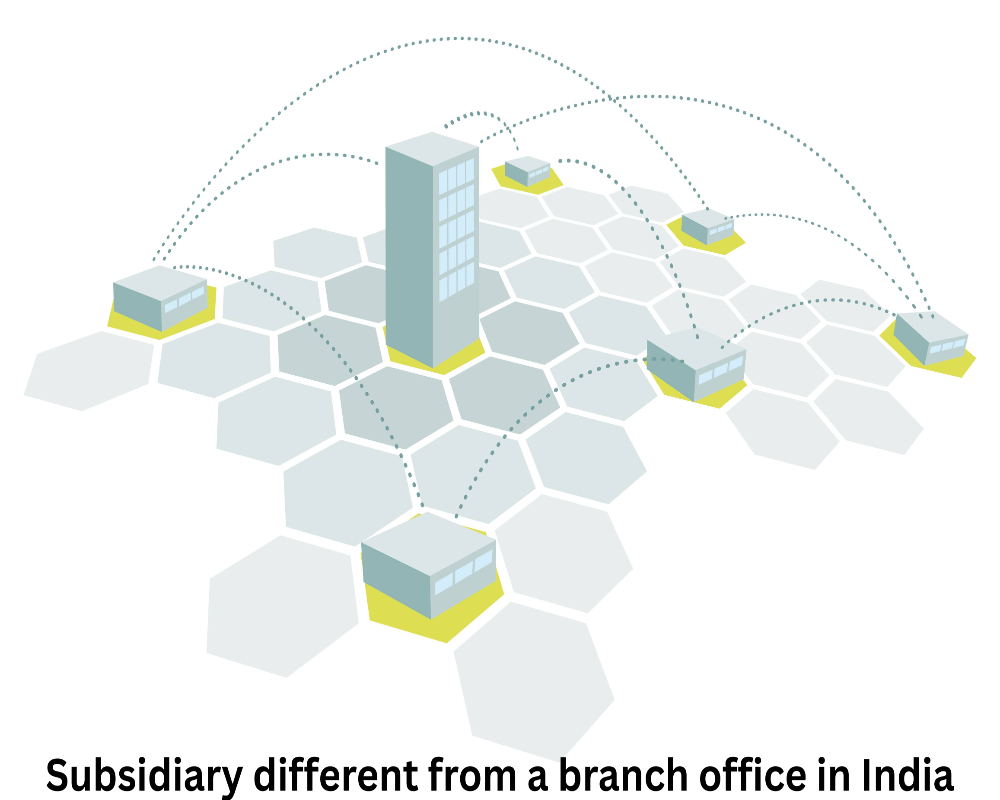

Legal Structure and Identity
- A subsidiary is an independent legal entity registered under the Companies Act, 2013
- A branch office is not a separate legal entity and functions as an extension of the parent company.
- Subsidiaries can own property, sue, or be sued independently.
- Branch offices cannot own assets or initiate legal proceedings independently.
- Subsidiaries have their own board and governance, while branch offices are governed by the parent company’s directives.
Ownership and Control
- A subsidiary may be wholly or partially owned by the parent company.
- A branch office is fully owned and directly controlled by the parent company.
- The parent appoints directors for subsidiaries, while branch offices operate under managers assigned by the parent.
- Subsidiaries make decisions locally under their board’s supervision.
- Branches follow centralized decision-making from the parent company headquarters.
Permitted Activities
- Subsidiaries can carry out any legal business activity permitted under Indian law.
- Branch offices are restricted to specific activities like export/import, research, and representation.
- Subsidiaries can engage in manufacturing, retail, or full-scale operations.
- Branch offices cannot engage in manufacturing directly in India.
- Subsidiaries have operational freedom, while branch offices require prior approvals for many functions.
Taxation and Compliance
- Subsidiaries are treated as domestic companies and taxed accordingly.
- Branch offices are taxed as foreign entities at higher corporate tax rates.
- Subsidiaries must comply with Indian accounting and reporting standards.
- Branch offices report to both Indian regulators and the foreign parent company.
- Transfer pricing and FEMA regulations apply to both, but subsidiaries have local tax registrations.
Regulatory Approvals
- Subsidiaries are registered with the Ministry of Corporate Affairs (MCA)
- Branch offices require Reserve Bank of India (RBI) approval under FEMA.
- Subsidiaries follow the Companies Act for operations and disclosures.
- Branch offices must report to the RBI and comply with additional foreign exchange norms.
- Setting up a subsidiary is often a more permanent solution compared to a branch office.
0 Comments